1. Common camera angles, shots, and movements in the film "Us":
- Close Up: The close up shots were mainly used to show the reactions of the actors after something shocking happened.
- Long shot: This shot was used to show everything on the actors body from head to toe.
- Tracking shot: This track showed the characters being followed by the camera throughout the movie
- Over the shoulder shot: This shot was used to build up suspension throughout the movie
- Establishing shot: This shot was used to set the scene
- Low angle: This angle showed the floor view of the victims being killed
2. Common CLAMPS / "Mis En Scene"
- Costume: The costume for this movie is a red tethered jumpsuit that looks similar to what prisoners wear except it was red.
- Lighting: The lighting in this movie was based off the time of day. For example during the day the lighting was bright and during the night it was dark so the actors weren't able to be seen as much as they normally would be seen in the daylight.
- Actors: The actors in this movie played the role of the antagonist and the protagonist which is why this movie was so unique. They played both roles because there were 2 of the same families from different places. One of the families were able to speak and the other family couldn't speak at all, other than the mother.
- Make up: Make up was used to create burn marks on one of the actors faces which could be considered as a special effect.
- Props: The main prop used in this movie was a pair of scissors that was carried by the antagonist throughout the movie.
- Setting: The setting of the movie took place at an old cabin and a pier where the mother grew up as a child.
3. Common Sound
-Diegetic sound: The diegetic sound in this movie mainly occurred outside. For example, at night time you were able to hear the crickets outside.
- Non diegetic sound: Sound effects were added when things were blown up such as the car scene.
- Dialogue: There was conversation throughout the entire movie.
- Incidental Music: This type of music was added in the scary parts of the movie to create suspense
4. Common editing in the movie
- Cutaway
-Action match
Reaction shot
Reverse shot
Eye-line match
5. Elements of this genre
- There is ongoing conflict and multiple plot twists.
-There is a lot of suspense.
- There are a lot of things that got in the way of the family escaping.
- You get a huge climax.
- There's always a surprise ending that leaves you questioning everything.
6 and 7: Elements that you do and don't like
- Our group likes all of the elements that come with the thriller genre because you never know when and where something is going to happen. The feeling of suspense keeps us interested in the movie which is a good thing from an audience members perspective. If we had to chose one thing that we didn't like it would be the surprise ending because some endings are confusing and they take a while to understand.
Sunday, January 26, 2020
Genre-Research-selection
Blog 2.5: The genre of the movie we will be creating the first two minutes of is thriller. A thriller movie is intended to scare by creating suspense. We decided this genre best fit our pitch because it's not a gory topic with nonrealistic characters. To be more specific, our film is about someone who kills people if they commit one of the seven deadly sins. We don't really clarify if this is a villain or a vigilante which leaves the audience to interpret this for themselves. Also, although we know what the motive of the killer is, the other characters in the movie don't which leaves them to be completely oblivious. This creates suspense about who the killer will kill, when, and why.
Genre-Research-Horror and Thriller
For more background on the differences between different genres, we researched two more genres: horror and thriller. Horror and thriller movies can usually be seen as very similar and in most instances they are. A lot of film makers make films that are both horror and thriller.
Horror- a film that is created to entertain by scaring the audience. Usually, horror can be gory which means LOTS of special effects makeup whether it's blood, gashes, etc.
Thriller- a film intended to scare with suspense.
Common camera angles, shots, and movements in a horror film:
1. Bird's eye view/high angle- these are usually used to show someone on the ground, possibly vulnerable to whatever is above it.
2. Close up- used to show the reactions of the characters.
3. Tracking shot- shows someone being followed.
4. Tilt- can signify a supernatural being.
5. Low angle- shows how intimidating a protagonist is.
6. Hand held- makes the film more realistic; ex. Blair Witch Project
7. POV- the audience is able to be scared exactly like the character
8. Over the shoulder- builds tension, can sometimes signify someone standing behind a person.
Common camera angles, shots, and movements in a thriller:
1. Establishing shot- sets an eerie mood.
2. Tracking shot- shows someone being followed.
3. Close up- used to show the reactions of the characters.
4. Tilt- can signify a supernatural being.
5. Over the shoulder- builds tension, can sometimes signify someone standing behind a person.
Mis en scene in horror movies:
Costumes- sometimes costumes can be very specific to the movie. What I mean by this is that if it's a horror movie with a supernatural protagonist such as Pennywise, the costume will obviously be a clown suit but the supporting characters may have on regular clothes.
Lighting- dark, eerie lighting.
Actors- actors usually vary but the most common thing they do is scream and fight.
Makeup- lots of special effects are used to add to the gory effect of the movie.
Props- whether it's used by the protagonist or the antagonist, there's always weapons used.
Setting- a lot of times in a made up town when including a supernatural being; sometimes secluded.
Mis en scene in thriller movies:
Costumes- usually regular clothes
Lighting- dark, eerie lighting.
Actors- actors usually vary but the most common thing they do is scream and fight.
Makeup- can show dirt or bruises from being chased and fighting back.
Props-whether it's used by the protagonist or the antagonist, there's always weapons used.
Setting- settings vary; sometimes secluded.
Common sounds and editing of horror and thrillers:
1. Diegetic sound- when the actor is quiet and you can hear all of their surroundings.
2. Non diegetic- the sounds of weapons, sounds of supernatural being.
3. Sound Motif
4. Incidental Music- suspenseful music.
5. Dialogue
6. Cutaway
7. Eye- line match
8. Jump cut
9. Reaction shot
Examples of horror films:
Horror- a film that is created to entertain by scaring the audience. Usually, horror can be gory which means LOTS of special effects makeup whether it's blood, gashes, etc.
Thriller- a film intended to scare with suspense.
Common camera angles, shots, and movements in a horror film:
1. Bird's eye view/high angle- these are usually used to show someone on the ground, possibly vulnerable to whatever is above it.
2. Close up- used to show the reactions of the characters.
3. Tracking shot- shows someone being followed.
4. Tilt- can signify a supernatural being.
5. Low angle- shows how intimidating a protagonist is.
6. Hand held- makes the film more realistic; ex. Blair Witch Project
7. POV- the audience is able to be scared exactly like the character
8. Over the shoulder- builds tension, can sometimes signify someone standing behind a person.
Common camera angles, shots, and movements in a thriller:
1. Establishing shot- sets an eerie mood.
2. Tracking shot- shows someone being followed.
3. Close up- used to show the reactions of the characters.
4. Tilt- can signify a supernatural being.
5. Over the shoulder- builds tension, can sometimes signify someone standing behind a person.
Mis en scene in horror movies:
Costumes- sometimes costumes can be very specific to the movie. What I mean by this is that if it's a horror movie with a supernatural protagonist such as Pennywise, the costume will obviously be a clown suit but the supporting characters may have on regular clothes.
Lighting- dark, eerie lighting.
Actors- actors usually vary but the most common thing they do is scream and fight.
Makeup- lots of special effects are used to add to the gory effect of the movie.
Props- whether it's used by the protagonist or the antagonist, there's always weapons used.
Setting- a lot of times in a made up town when including a supernatural being; sometimes secluded.
Mis en scene in thriller movies:
Costumes- usually regular clothes
Lighting- dark, eerie lighting.
Actors- actors usually vary but the most common thing they do is scream and fight.
Makeup- can show dirt or bruises from being chased and fighting back.
Props-whether it's used by the protagonist or the antagonist, there's always weapons used.
Setting- settings vary; sometimes secluded.
Common sounds and editing of horror and thrillers:
1. Diegetic sound- when the actor is quiet and you can hear all of their surroundings.
2. Non diegetic- the sounds of weapons, sounds of supernatural being.
3. Sound Motif
4. Incidental Music- suspenseful music.
5. Dialogue
6. Cutaway
7. Eye- line match
8. Jump cut
9. Reaction shot
Examples of horror films:
“IT”-2017
“The Conjuring”- 2013
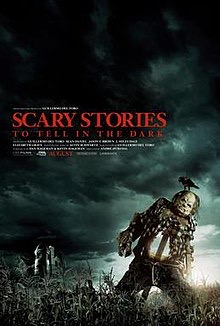
“Scary Stories to Tell in the Dark”-2019
Examples of thrillers:
“A Quiet Place”-2018
“Us”-2019
“Extremely Wicked, Shockingly Evil and Vile”-2019
“Split”-2016
Genre- Research- WAR
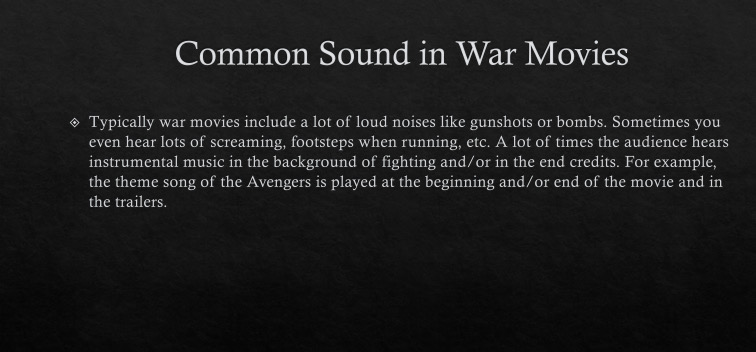
Earlier on in the year, my group mates and I had come together to comment on the elements that build up a movie of the war genre. This PowerPoint consists of 12 slides that we used to elaborate on such. One element that we had focused on was the camera movements, angles and shots. In our class, this is referred to as C.A.M.S. We also provided visual examples to support this. We also included the most en scene, represented by the acronym C.L.A.M.P.S. This stands for costume, lighting, actors, makeup, props and setting. We also elaborated on elements that build the genre. This includes the editing of the film, which was also supported with visual example. We inserted images of movies that fall under the genre as well. Finally, we also inserted elements that we did and didn’t like in that genre of film.
Genre- Research-Bird Box
1.) Common Camera Angles (CAMS)
-High angles
In the movie, there were majority high angles. This varied from slightly above eye level to aerial shots in order to convey different purposes, mostly towards the climax and the end of the movie. For example, when Tom went outside to check who was at their door, the people unaffected by the murderous force were viewed from a high angle purely because of the angle that Tom was standing at, somewhat similar to a POV shot. However, the scene where they had to travel the river (nearing the waterfall), the high shot was utilized to show how drastic and treacherous the situation had become.
- Wide Shots
Wide shots were extremely common, and were used not only as establishing shots, but as shots to drive and evoke emotion. It was noticed that wide shots are always used in some way, shape or form when the force takes over the people. (Except for Tom). When Saundra was hit by the bus, when the mother of Boy (Olympia) jumped out the window, and when the old lady(Cheryl) collapses after stabbing herself. It can be noticed that all these shots took place at their deaths, perhaps to give the viewer the full visual of what had occurred
- Close ups
Close ups were also commonly used shots, but they were used for a different aspect of the possession. While wide shots were used to show the product of the force, the close ups were used to show the event taking place. This, also contrary to the wide shots, apply to every individual. Right before their deaths, there would be a close up of the fear on the faces of those impacted right before they die, most likely utilized in order to represent them being impacted by the force. (They were used in other senses, but this is the most frequent utilization)
- Zooms
Zooms were extremely common and occurred typically between a medium shot to a close up. They were used to enhance close ups in order to further excel the mood that the creators intended to display. However, this was not the only purpose, and they were also used to accompany tracking shots.
- Tracking Shots
Tracking shots were used very frequently throughout the film. Similar to high angles, their use was very versatile and was inserted for many different purposes throughout the film. In the beginning during the hospital scene as she walked past the lady banging her head on the glass; as she was driving with Saundra, who later crashed the car; and as she was running with the group to find a place of refuge. This was the most common use. However, towards the end the purpose of a tracking shot changed- although used to follow people nonetheless, it was also used to surround them as the camera circled the faces of focus. This was seen when Tom became impacted by the force as well as when the main character heard the sounds of the force and ran with her children to the sanctuary.
2.)Mis en scene (CLAMPS)
- Costume: in the beginning of the movie, everyone wore vibrant and clean clothing. However, as situations deteriorated, clothes became dull and dirty (climax to falling action). As the movie came to a close as they entered the safe place (school for the blind), the clothes, though never returning to the level of brightness it once was, returned to its clean state.
- Lighting: the movie, as commonly seen in thrillers, had started out with bright lighting. Partially attributed to the close and setting, the colors bursted through the screen in the first few minutes of the film. This was met with a contrast after the death of Saundra— the colors were no longer bright, though the light still shone, and as the film progressed, the lighting gradually became darker and less vibrant up until they found refuge in the school.
- Acting/Actors: the actors used to create this movie were experienced in their craft and included people such as Sandra Bullock, Trevante Rhodes and Jacki Weaver. The excellent acting skills of every individuals propel the film, contributing to its immense success.
-Makeup: aside from your average makeup design in the beginning of the film, the sole purpose of makeup in this film was to make the characters look worn and dirty or to add blood for effect. This included full body makeup.
- Setting: the setting was elaborately thought out and planned. Although a few of the scenes were attributed to green screen, most of them were properly scouted by the producers. The most commonly used setting was likely the forest, which was used when the mother and her two children ultimately had to travel alone to find safety.
3.) Common Editing
- Cut: cuts were extremely common, simply because they are the most basic transition between non-correlated elements.
- cross cutting: cross cutting was seen throughout the film in various representations; most commonly between a POV shot of them looking through the blind folds and their present actions. An example of this is towards the end when they are running up the stairs and there is a constant switch between the blind fold POV and an extreme close up of the family scurrying up the stairs
- shot reverse shots: shot reverse shots were also extremely common, used in most every two person dialogue.
4.) Common sound:
-Scores: scores were the most common usage of background sound in the film. Music in the background was intense, but under no circumstance did they use words or a singer to contribute to that.
- Diegetic sound: diegetic sound was used throughout the film. Steps, creaks, scratches, ruffling, and leaves were all used appropriately according to the location and the action.
-Dialogue: dialogue was also used very frequently; there was constant communication between the characters in the movie so long as they were not alone.
-Non-diegetic sound: on occasion when the force would come on the people, particularly towards the end, you would hear noises that did not properly suit the scene or location. The best exams ple of this is at the end when the main character hears Tom calling her to look at him even though he’s already dead. His voice does not fit into that scene, nor did the noise that accompanied his pleas.
5&6.) Elements we liked and didn’t like
- The use of lighting and color design in the film was marvelously executed throughout the film. The contrast between the beginning and the ending of the movie was subtle but impactful, slowly luring the audience. However, everything including the execution, the editing and the shots were marvelously placed to create this excellent film. The camera movements and angles were excellently placed for it to seem realistic, and the editing used for the glint in the eyes was spectacular, and really. improved what already was excellent acting.
I found no fault with this film.
- Lighting: the movie, as commonly seen in thrillers, had started out with bright lighting. Partially attributed to the close and setting, the colors bursted through the screen in the first few minutes of the film. This was met with a contrast after the death of Saundra— the colors were no longer bright, though the light still shone, and as the film progressed, the lighting gradually became darker and less vibrant up until they found refuge in the school.
- Acting/Actors: the actors used to create this movie were experienced in their craft and included people such as Sandra Bullock, Trevante Rhodes and Jacki Weaver. The excellent acting skills of every individuals propel the film, contributing to its immense success.
-Makeup: aside from your average makeup design in the beginning of the film, the sole purpose of makeup in this film was to make the characters look worn and dirty or to add blood for effect. This included full body makeup.
- Setting: the setting was elaborately thought out and planned. Although a few of the scenes were attributed to green screen, most of them were properly scouted by the producers. The most commonly used setting was likely the forest, which was used when the mother and her two children ultimately had to travel alone to find safety.
3.) Common Editing
- Cut: cuts were extremely common, simply because they are the most basic transition between non-correlated elements.
- cross cutting: cross cutting was seen throughout the film in various representations; most commonly between a POV shot of them looking through the blind folds and their present actions. An example of this is towards the end when they are running up the stairs and there is a constant switch between the blind fold POV and an extreme close up of the family scurrying up the stairs
- shot reverse shots: shot reverse shots were also extremely common, used in most every two person dialogue.
4.) Common sound:
-Scores: scores were the most common usage of background sound in the film. Music in the background was intense, but under no circumstance did they use words or a singer to contribute to that.
- Diegetic sound: diegetic sound was used throughout the film. Steps, creaks, scratches, ruffling, and leaves were all used appropriately according to the location and the action.
-Dialogue: dialogue was also used very frequently; there was constant communication between the characters in the movie so long as they were not alone.
-Non-diegetic sound: on occasion when the force would come on the people, particularly towards the end, you would hear noises that did not properly suit the scene or location. The best exams ple of this is at the end when the main character hears Tom calling her to look at him even though he’s already dead. His voice does not fit into that scene, nor did the noise that accompanied his pleas.
5&6.) Elements we liked and didn’t like
- The use of lighting and color design in the film was marvelously executed throughout the film. The contrast between the beginning and the ending of the movie was subtle but impactful, slowly luring the audience. However, everything including the execution, the editing and the shots were marvelously placed to create this excellent film. The camera movements and angles were excellently placed for it to seem realistic, and the editing used for the glint in the eyes was spectacular, and really. improved what already was excellent acting.
I found no fault with this film.
Friday, January 17, 2020
Final 2 Pitches
After talking it over with my group, we have narrowed it down to two pitch ideas for our final task. We decided it would be easier to do this by going over the pros and cons of each individual pitch. In the end, we decided to narrow it down to a pitch I came up with and a pitch my team member, Jahrvia, created. To refresh, the pitch idea I came up with was: All of the most infamous antagonists join together to wreak havoc on the world. The antagonists would include villains such as Dracula, Frankenstein, and Penny Wise. The pitch Jahrvia came up was: A person (or group) kills people who have been listed for committing the seven deadly sins. The killer in this film would be a person that personally knows each of the people listed.
In order to decide which pitch to use, as stated before, we explored the pros and cons of each pitch. First we started with my pitch. Some benefits to my pitch are:
1. It features classic characters that the audience knows and brings them together as one (almost like the Avengers or Suicide Squad).
2. Since people know of these characters, it attracts fans of all the antagonists, bringing more people to the box office.
3. With the same previous characters, as the directors, we have the opportunity to present a new hero or even join together the protagonists from each of the antagonists' movies.
Some cons to my pitch are:
1. Realistically, getting the rights to each specific character would be hard. It would cost a fortune and could take forever.
2. After thinking about it, it sounds a little too much like the movie and book series, Goosebumps by R.L. Stine.
3. Special effects for some of the antagonists would be very difficult to recreate since none of us are professional in makeup.
Next, we went over the pros and cons of Jahrvia's pitch. The pros included:
1. It was something we had never seen before.
2. We could get a message across in the opening credits easily.
3. The "killer" character could be seen as a villain or a vigilante which allows for complexity.
4. Not much special effects makeup is needed since these are normal human beings.
I personally couldn't think of any major cons to Jahrvia's pitch.
With that being said, we decided to use Jahrvia's pitch about the seven deadly sins.
In order to decide which pitch to use, as stated before, we explored the pros and cons of each pitch. First we started with my pitch. Some benefits to my pitch are:
1. It features classic characters that the audience knows and brings them together as one (almost like the Avengers or Suicide Squad).
2. Since people know of these characters, it attracts fans of all the antagonists, bringing more people to the box office.
3. With the same previous characters, as the directors, we have the opportunity to present a new hero or even join together the protagonists from each of the antagonists' movies.
Some cons to my pitch are:
1. Realistically, getting the rights to each specific character would be hard. It would cost a fortune and could take forever.
2. After thinking about it, it sounds a little too much like the movie and book series, Goosebumps by R.L. Stine.
3. Special effects for some of the antagonists would be very difficult to recreate since none of us are professional in makeup.
Next, we went over the pros and cons of Jahrvia's pitch. The pros included:
1. It was something we had never seen before.
2. We could get a message across in the opening credits easily.
3. The "killer" character could be seen as a villain or a vigilante which allows for complexity.
4. Not much special effects makeup is needed since these are normal human beings.
I personally couldn't think of any major cons to Jahrvia's pitch.
With that being said, we decided to use Jahrvia's pitch about the seven deadly sins.
Pitching an Idea
A pitch is basically a film encapsulated in 25 words or less, it's usually one sentence. The concept is one based off of an elevator pitch, a pitch that emphasizes concision as if you were trying to sell your idea within the span of an elevator trip.
Pitch 1: All of the most infamous antagonists join together to wreak havoc on the world. This pitch falls into the horror genre because it's meant to scare the audience. The antagonists would include villains such as Dracula, Frankenstein, and Penny Wise.
Pitch 2: A bridesmaid is obsessed with the bride, her twin and she plans to kill her in order to take her identity. Thus pitch falls into the thriller genre because it is meant to create suspension and fear in the audience. The bridesmaid envy's her sister and will go great lengths to take over her life even if that includes killing her.
Pitch 3: A person (or group) kills people who have been listed for committing the seven deadly sins. This idea is in the horror/thriller genre because it is a film that will induce terror in viewers. The killer in this film would be a person that personally knows each of the people listed. Therefore, the killer would have reason for murdering each person because they personally know that they've done it.
Subscribe to:
Posts (Atom)